



When you look at a recliner in a showroom, your eyes naturally follow the silhouette before you ever sit down.
You notice the way the light hits the fabric and how the backrest curves to meet the spine.
For a professional buyer, these design cues are the primary indicators of how a product will perform in a customer’s home.
What is a Compact Manual Recliner?
A compact manual recliner is a functional seating solution that balances ergonomic support with a streamlined aesthetic. Unlike traditional, oversized loungers, this design category is defined by its proportional balance—combining a slim-profile armrest with a segmented backrest system.
The "compact" element refers to the chair’s ability to provide a full-extension recline while maintaining a narrow external footprint. At GeekSofa, we define this product as a hybrid of modern residential styling and traditional mechanical reliability, specifically engineered to solve the problem of visual bulk in contemporary living spaces.
The Anatomy of the Segmented Backrest
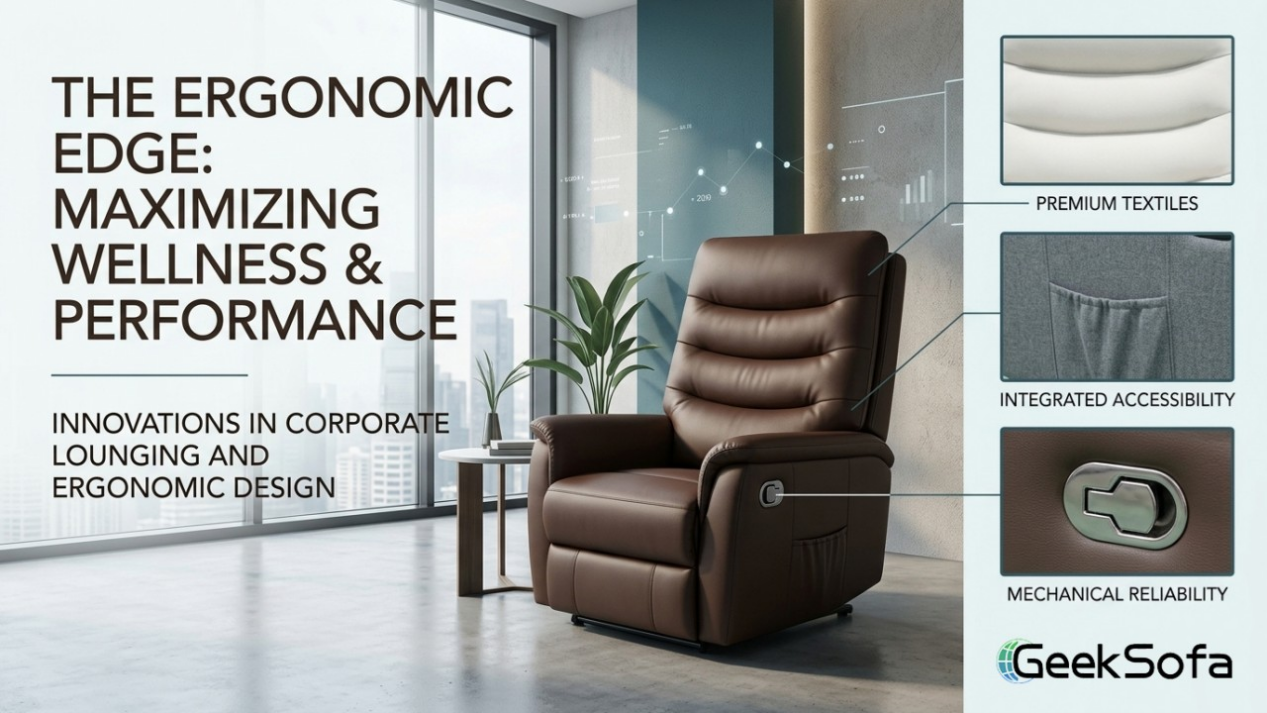
If you look closely at the product images, the most striking feature is the four-tier segmented backrest. This isn't a decorative choice; it is a structural solution for long-term comfort.
In many standard recliners, the back is one large cushion. Over time, the filling (usually polyester fiber) naturally gravitates toward the bottom, leaving the middle and top sections flat and unsupportive.
The GeekSofa Design Logic:
Zoned Support: By partitioning the backrest into four horizontal segments, we anchor the filling. Each section—from the headrest to the lumbar area—is independently stuffed.
The "S-Curve" Alignment: The middle segments are calibrated with a slightly firmer density to meet the thoracic and lumbar spine. This ensures that when the user leans back, the chair "fills the gap" in their lower back rather than letting them sink into a hollow space.
This segmented approach ensures the chair maintains its "brand new" silhouette and supportive feel even after years of daily use.
Flared Arms: Balancing Form and Function
The armrests are the most visible "space-takers" on any chair. In our latest manual series, we moved away from the traditional "pillow arm" in favor of a flared narrow profile.
Visual Lightness: The outward flare gives the chair an inviting, open appearance without adding unnecessary width to the base.
Seating Freedom: By slimming down the armrest structure, we maximize the internal seating area. This allows a user to feel "unconfined" even though the chair itself has a much smaller physical footprint than a classic American-style recliner.
Modern Aesthetics: The clean lines of the narrow arm help the chair blend into a modern living room or home office, moving away from the "medical equipment" look that some functional furniture suffers from.
The Tactile Experience: Tech Fabric and Hand-Feel
Material choice is where a design truly comes to life. For this series, we prioritize High-Performance Tech Fabrics (often referred to as Leathaire).
When you run your hand over the surface, you notice a matte, sophisticated texture that mimics the depth of top-grain leather. However, unlike traditional leather or cheap PU, this material is engineered for breathability.
Zero Temperature Lag: It doesn't feel cold in the winter or sticky in the summer.
Texture Integrity: The micro-porous surface provides a "soft touch" that complements the firm support of the internal foam.
We ensure all our materials meet CAL TB117-2013 or BS 5852 standards, ensuring that the tactile beauty of the chair is backed by international safety compliance.
The Simplicity of the Manual Motion
There is a specific satisfaction in the "analog" feel of a manual recliner. In our [Internal Link: "Understanding Mechanical Integrity in Manual Seating"], I’ve previously discussed why mechanical simplicity is often the ultimate luxury.
The recessed black D-ring handle on the side of the chair is designed for an intuitive, low-effort release.
Immediate Response: Unlike power versions that move at a fixed motor speed, the manual mechanism responds to the user’s body weight and momentum.
The Three-Position Flow: The chair moves seamlessly from an upright reading position to a "TV-viewing" angle, and finally to a full-flat recline.
By focusing on a high-tensile alloy steel frame, we ensure that the transition between these positions is smooth, quiet, and requires minimal physical exertion from the user.
Thoughtful Details: The Human Element
Design isn't just about the big pieces; it’s about the small additions that make daily life easier.
The Side Pocket: We’ve integrated a deep side pocket that follows the seam of the chair. It’s a simple addition that keeps tablets, remotes, or magazines within reach, acknowledging how people actually use their furniture in a digital age.
Double-Stitched Seams: If you look at the edges of the flared arms, you’ll see double-stitching. This provides a clean, tailored finish and reinforces the stress points where the fabric meets the frame.
Conclusion: A Design Built for Longevity
At GeekSofa, we believe that a recliner should be a sanctuary, not a complicated piece of machinery. By focusing on segmented support, spatial efficiency, and material texture, we provide a product that fits into the modern home and the modern lifestyle.
When you choose a SKU for your collection, you are choosing the design logic that sits behind it. And our logic is simple: provide a chair that supports the body, respects the space, and lasts for years.
FAQ: Design and Functional Insights
Q1: Why is the backrest segmented into four parts instead of three?
The four-segment design allows for a more precise "contouring" of the human back. It provides a dedicated section for the neck, the upper back, the lumbar region, and the base of the spine, preventing the filling from shifting and clumping in any one area.
Q2: Is the "Tech Fabric" easy to clean for families with pets?
Yes. One of the primary design benefits of Tech Fabric is its durability. It has a high abrasion resistance and is much easier to wipe down than traditional woven fabrics, making it ideal for high-traffic living rooms.
Q3: How does the "Flared Arm" affect the stability of the chair when reclining?
The flare is purely aesthetic and ergonomic for the arms; the internal frame remains a vertical, solid wood and steel structure. The chair’s stability is derived from the wide alloy steel base, which remains grounded even in full-recline mode.
Q4: Can the side pocket hold heavier items like a laptop?
The pocket is designed for tablets, remotes, and books. For heavier items, the reinforced stitching ensures the pocket won't sag or tear away from the main frame, though it is optimized for standard handheld devices.
Q5. How much effort is required to close the footrest manually?
We use a balanced tension spring system. Closing the footrest requires a simple leg-press motion. We calibrate the resistance to be firm enough to stay locked, but accessible enough for elderly users to operate without strain.
Post time: May-06-2026


