



In the functional furniture industry, the transition from a standard three-seater to a five-piece Corner Recliner Sofa introduces a geometric increase in manufacturing complexity.
For professional furniture buyers and category experts, the primary concern isn't aesthetic—it is the long-term structural alignment of modular components.
When a sectional fails, it is rarely a total collapse; it is a 3mm misalignment in the wedge or a slight tension variance in the tech-fabric that kills the retail value.
What is High-Consistency Sectional Recliner Manufacturing?
High-consistency Corner Recliner Sofa manufacturing is an integrated production framework focused on eliminating variance across modular units.
It involves synchronizing the mechanical tension of the reclining mechanisms, calibrating upholstery tension across different dye lots, and ensuring the structural integrity of the corner wedge to prevent frame "racking."
For an OEM/ODM supplier, this means delivering bulk orders where every module—from the armless chair to the power console—is interchangeable and perfectly leveled.
Market Dynamics: The Post-Bonded Leather Era
The shift in the global furniture market from bonded leather to High-GSM (Grams per Square Meter) Tech-Fabric is now a baseline reality. This shift is driven by the retail sector's demand for materials that offer the matte aesthetic of leather without the risk of hydrolysis (peeling).
However, from an engineering perspective, Tech-Fabric presents its own set of variables. Because these fabrics are typically multi-layer composites, their elasticity differs from traditional polyesters. A common industry pain point is "seam puckering" or surface sagging after 6-12 months of use.
An impartial analysis of current production standards suggests that success in this category depends on the foam-to-fabric calibration. Using high-resilience (HR) foam with a specific density—typically exceeding 28kg/m³—is necessary to provide the counter-tension required to keep Tech-Fabric taut over long-term use.
The Engineering Challenge of the Modular "Wedge"
The corner wedge is the pivot point of any sectional recliner line. It is historically the most vulnerable component because it must withstand the torque generated by reclining units on either side.
In the current manufacturing landscape, frame stability is determined by three "invisible" factors:
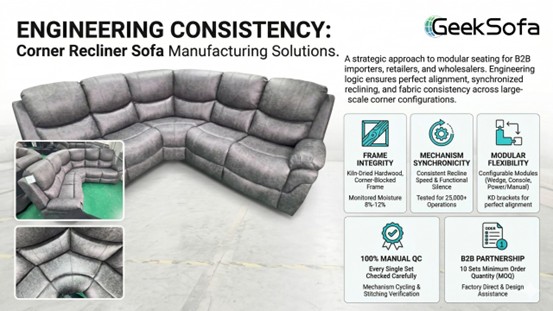
- Moisture Control: Utilizing kiln-dried hardwood with a 8%-12% moisture range to prevent the frame from warping during trans-oceanic shipping.
- Reinforcement Logic: Moving beyond simple staples to glued and screwed corner blocks.
- Bracket Precision: The alignment of KD (Knock-Down) Brackets must be verified using steel jigs. Even a minor deviation in bracket placement leads to the "stair-step" effect, where modular pieces do not sit flush on the floor.
Quality Protocols: Beyond Percentage-Based Checking
Functional furniture differs from stationary upholstery because it involves moving parts. The industry standard has traditionally been "AQL (Acceptable Quality Level)" sampling. However, for large-scale Corner Recliner configurations, many factories are pivoting toward a 100% Manual Inspection Protocol.
As observed in professional production environments (including the factory floor checking seen in the recent GeekSofa footage), this protocol focuses on Mechanism Synchronicity. When multiple recliners are placed in a row, the footrest extension speed and backrest pitch must be uniform. This requires a 14-gauge steel mechanism that is cycle-tested for 25,000+ operations. Checking "every single set" isn't a marketing claim—it is a logistical necessity to prevent the high cost of return-logistics for bulky items.
Sourcing Strategies for Inventory Flexibility
A significant trend in B2B furniture sourcing is the reduction of "dead stock" risk. Committing to a full 40HQ container of a single SKU is increasingly seen as high-risk by medium-sized wholesalers.
The industry response has been the implementation of Low MOQ (Minimum Order Quantity) Solutions, such as 10-set thresholds. This allows buyers to:
l Test regional color preferences (e.g., neutral greys vs. earth tones) in real-time.
l Evaluate the market response to manual versus power configurations.
l Iterate on OEM/ODM design adjustments—such as the integration of USB-C charging or modified armrest widths—without excessive capital lock-up.
Compliance and Safety Standards: The Professional Barrier
For regulated markets (USA, UK, EU), compliance is not a "feature" but a legal prerequisite. The focus remains on Fire Retardancy (FR)—such as CAL117 or BS5852—and the certification of electrical components (UL/CE).
A professional Recliner Sofa Manufacturer must ensure that these certifications are integrated into the Bill of Materials (BOM) from the prototyping stage, rather than treated as an afterthought.
FAQ: Technical Sourcing for Procurement Experts
Q1: How is color consistency maintained across different modular production batches?
Consistency is managed through "Dye-Lot Control." In professional manufacturing, all fabric for a single container or order is sourced from the same production run at the textile mill. This eliminates the "shade-variation" between the corner wedge and the side seats.
Q2: What is the benefit of the "Triple-Pillow" backrest for retail sales?
From an ergonomic standpoint, the triple-pillow (or waterfall) design allows for localized support in the neck, thoracic, and lumbar regions. In a retail "sit-test," this zonal support provides immediate comfort feedback, which is a key driver for consumer conversion.
Q3: How do you prevent mechanism noise or friction in power sectionals?
Quiet operation depends on the quality of the motor and the lubrication of the steel joints. Using certified motors (e.g., Okin or equivalent) and high-tolerance steel bushings prevents the "metal-on-metal" grinding sound common in budget-tier recliners.
Q4: Can modular sections be replaced individually if damage occurs?
Yes. A modular design using standardized KD Brackets allows for individual unit replacement. This is a significant advantage for wholesalers, as it reduces the cost of resolving customer claims—you only replace a single chair rather than the entire sectional.
Q5: How is "Friction Burn" prevented during long-haul shipping?
Protection involves three layers: a soft EPE foam wrap, reinforced corner protectors, and a heavy-duty 5-layer corrugated carton. For Tech-Fabric, preventing the fabric from rubbing against the carton wall during vibration is critical to maintaining the surface finish.
Post time: May-08-2026


