



1. European Aging & Care Landscape: A Structural Demand Shift
Europe is entering a long-term demographic transition rather than a short-term demand cycle. The aging population is not only growing—it is reshaping how care is delivered, financed, and purchased.
The number of people in need of long-term care (LTC) in the EU is projected to increase from 30.8 million to 38.1 million by 2050, placing sustained pressure on healthcare systems and home care infrastructure.
At the same time, rising life expectancy and the doubling of the 60+ population globally are directly increasing demand for mobility and assistive equipment.
This shift is reflected in market data:
Europe mobility aids market projected to exceed USD 9.33 billion by 2031
Lift chair recliner segment expected to grow at around 8.8 percent CAGR
Long-term care market continues steady expansion with growing reliance on formal providers
The implication is clear: Demand is not driven by consumer trends, but by demographic inevitability.
2. Market Reality: Shift from Institutional Care to Home-Based Care
Across Europe, care delivery is shifting from institutional settings toward home-based and community care.
Home healthcare has already become the dominant segment within long-term care services. This transition is driven by:
Cost control pressures on public systems
Patient preference for aging in place
Workforce shortages in professional care facilities
For buyers—especially distributors, rehabilitation suppliers, and elderly care solution providers—this changes product requirements fundamentally.
Key implication:
Products are no longer evaluated only as “medical equipment,” but as part of daily living environments.
This is where lift chair recliners occupy a unique position:
Bridge between furniture and medical device
Enable independence without requiring full-time caregiver support
Reduce physical strain on both patients and caregivers
3. Buyer Pain Points in Europe (Elderly Care & Rehabilitation Sector)
From a professional buyer perspective, the decision-making process is increasingly structured and risk-aware. Key concerns include:
3.1 Safety & Compliance Risk
Europe maintains strict regulatory standards (CE, EN certifications), and buyers must ensure:
Mechanical reliability over long-term use
Stable lifting without tipping risk
Safe load distribution for elderly users
Failure in this area is not just a product issue—it is a liability issue.
3.2 Care Efficiency & Labor Pressure
With caregiver shortages rising across Europe, buyers prioritize:
Products that reduce manual assistance
Solutions that enable independent sitting and standing
Equipment that minimizes training requirements
Patient handling equipment demand is growing partly due to efficiency improvements and training needs.
3.3 Adaptability to Multiple Use Scenarios
Unlike hospitals, home care environments are diverse:
Small apartments in urban Europe
Nursing homes with shared spaces
Rehabilitation centers requiring flexible configurations
Buyers increasingly prefer modular or customizable products rather than fixed solutions.
3.4 Long-Term Reliability vs. Cost Pressure
European buyers are cost-sensitive—but not price-driven.
Their focus:
Total lifecycle cost (not just purchase price)
Maintenance frequency
Durability over years of use
This is particularly important as assistive devices are expected to serve long-term care needs rather than short-term recovery.
3.5 User Experience & Acceptance
Elderly users are not passive recipients—they actively influence purchasing decisions.
Key expectations:
Comfortable seating for long durations
Smooth, non-intimidating operation
Aesthetic compatibility with home interiors
This explains the increasing demand for ergonomic and “health-promoting furniture” in Europe.
4. Product Role: Where Lift Chair Recliners Fit
Lift chair recliners are not competing directly with wheelchairs or hospital beds. Instead, they serve a distinct functional gap:
Core Function:
Assist safe transition between sitting and standing positions.
Extended Value:
Reduce fall risk
Support rehabilitation recovery
Enable independent living
As mobility-related conditions rise globally, lift chairs are becoming a key category within assistive technology.
5. GeekSofa Product Value Analysis (Aligned with European Buyer Expectations)
Based on the above market dynamics, the value of GeekSofa products can be evaluated through a buyer-centric lens.
5.1 Controlled Manufacturing & Quality Consistency
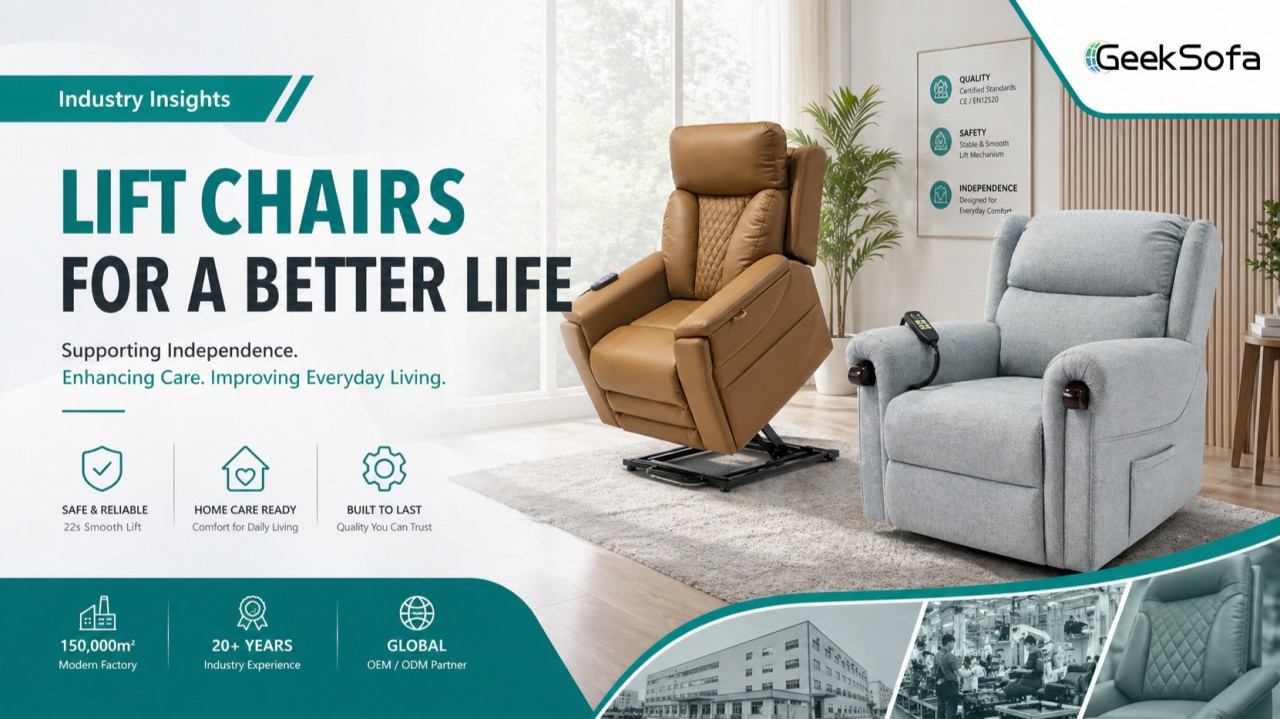
With a 150,000 sqm factory and ISO 9001, BSCI, CE, EN12520 certifications, GeekSofa aligns with Europe’s compliance-driven procurement environment.
For buyers, this reduces:
Certification risk
Supply chain uncertainty
Quality inconsistency across batches
5.2 Stable Lift Mechanism (22s Transition)
The 22-second lifting process reflects a key requirement:
Not speed, but controlled movement.
For elderly users:
Sudden motion increases fall risk
Gradual lifting improves confidence and safety
This aligns directly with European safety expectations.
5.3 Product Line Depth & Customization (OEM/ODM)
European distributors and care providers rarely operate in a single segment.
They require:
Different models for home care vs. nursing homes
Variations in size, fabric, and function
Private labeling or localized branding
GeekSofa’s OEM/ODM capability supports:
Market-specific adaptation
Faster response to regional preferences
Integration into existing product portfolios
5.4 Balance Between Medical Function & Furniture Design
One of the most underestimated buying factors in Europe is aesthetics.
Lift chairs are often placed in:
Living rooms
Assisted living apartments
Rehabilitation lounges
Products must:
Look like furniture
Function like medical equipment
This dual positioning is increasingly critical.
5.5 Production Capacity & Delivery Stability
European buyers value delivery reliability as much as product quality.
With large-scale production capacity:
Bulk orders can be fulfilled consistently
Lead times become predictable
Seasonal demand fluctuations can be managed
This is particularly relevant for distributors handling public tenders or institutional contracts.
6. Market Trends to Watch (2026 and Beyond)
6.1 Integration with Smart & Connected Systems
While still emerging, integration with smart home ecosystems is gaining attention:
Remote control via apps
Monitoring usage patterns
Integration with fall detection systems
6.2 Increased Focus on Home Rehabilitation
Post-surgery and chronic disease recovery are shifting toward home environments.
Lift chairs are becoming part of:
Post-operative care packages
Rehabilitation support solutions
6.3 Sustainability & Material Transparency
European buyers increasingly evaluate:
Material sourcing
Environmental impact
Product lifecycle sustainability
Compliance is expanding beyond safety into ESG expectations.
6.4 Hybrid Distribution Models
Traditional distributors are combining:
Medical equipment channels
Furniture retail
E-commerce platforms
Suppliers need flexibility to support multi-channel strategies.
7. Conclusion: A Functional Category Becoming Strategic
Lift chair recliners are no longer niche products.
They are becoming:
A core component of home-based elderly care
A solution to workforce shortages
A bridge between comfort, safety, and independence
For European buyers, the decision is not just about product features—but about how well a supplier understands:
Care system evolution
Regulatory expectations
End-user behavior
Manufacturers that align with these realities—through compliance, stability, customization, and scalable production—are better positioned to integrate into long-term procurement strategies.
FAQ
1. What drives demand for lift chair recliners in Europe?
The primary drivers are an aging population, increased long-term care needs, and the shift toward home-based care solutions.
2. Are lift chairs considered medical devices or furniture?
They function as a hybrid—medical assistive equipment with furniture-level usability and design.
3. What certifications are important for entering the European market?
CE marking, EN standards (such as EN12520), and quality systems like ISO 9001 are essential.
4. What do European buyers prioritize most?
Safety, compliance, long-term reliability, and adaptability to different care environments.
5. How is the market expected to evolve?
Growth will continue steadily, with increasing focus on home care, smart integration, and sustainable product design.
Post time: May-06-2026


