



Many EHPAD residents can still stand with assistance. The difficult part is often the repeated movement from a seated position to a stable standing posture.
This is where a fauteuil releveur, medical lift chair or power lift chair has a clearer role: not as a hospital treatment device, and not as a specialist pressure care chair, but as a daily seated mobility chair for older people who still move, still sit for long periods, and still need support during routine sit-to-stand moments.
For French medical equipment distributors, home care centres and care-home furniture buyers, this distinction matters. A lift chair used in an EHPAD, maintien à domicile programme or matériel médical channel has to be understood differently from a standard household recliner.
France’s ageing care context makes seating more specific
France has a clear aged care pressure point. DREES projects that by 2050, nearly 23 million people aged 60 or above will live in France, around 5 million more than in 2021. The same study projects 738,000 additional older people with loss of autonomy by 2050. It also notes that, without additional EHPAD capacity, residents in these facilities would be increasingly concentrated among people with severe loss of autonomy.
DREES has also reported that France had around 7,500 EHPAD facilities and nearly 615,000 places in 2022.
These figures do not prove that every care facility is replacing its seating. They do explain why aged care seating should be discussed with more precision. In EHPAD and home care settings, a chair may be used in a private resident room, a shared lounge, a home-care showroom or a medical equipment shop. The buyer is not only looking for comfort. They need a seating option that fits the way older people sit, rest, adjust position and prepare to stand during the day.
Sit-to-stand is a daily care moment
The lift function is often described too simply. It is not just about “standing up easily.”
In many care settings, sit-to-stand is a repeated care moment. A resident may sit after lunch, rest in the afternoon, raise the legs for comfort, lower the footrest, shift forward, then prepare to stand with support from a caregiver. If the seat is too low, too soft or too deep, the transition can become harder than it needs to be.
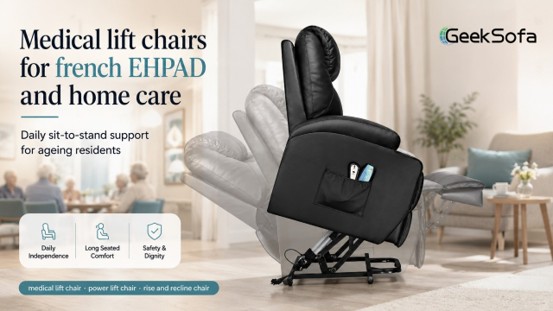
A medical lift chair supports this moment by raising the seat and bringing the user closer to a standing-ready position. For residents with partial mobility, that can make the movement more manageable. For caregivers, predictable powered movement can reduce unnecessary pulling or awkward support during routine transfers.
This is where a rise and recline chair becomes different from a standard recliner. The value is not in adding more functions. The value is in making one common daily movement more stable.
Long seated time needs support, not overclaiming
Pressure care is part of aged care seating, but it should be discussed carefully.
NICE guidance on pressure ulcer prevention and management highlights risk assessment, repositioning, pressure redistributing devices and individual care planning. It also advises care providers to consider the seating needs of people at risk of pressure ulcers who sit for prolonged periods.
That does not mean a normal medical lift chair should be marketed as a pressure ulcer treatment product. Unless a chair is specifically designed, tested and certified for that clinical purpose, the more responsible value is longer seated comfort, easier position adjustment and better support during everyday sitting.
For medical shops and care-home furniture distributors, this distinction protects trust. A product that is easy to explain without exaggerated clinical claims is easier to place in a professional channel.
A well-designed lift chair can still make a practical difference through:
- supportive cushioning for longer seated comfort
- stable backrest and leg-rest adjustment
- easier movement between resting and standing positions
- fabrics suitable for frequent cleaning
- a structure built for repeated powered movement
That is a more credible conversation than presenting a lift chair as a cure-all seating solution.
Why ordinary recliners can be difficult in care channels
A standard recliner may look comfortable in a living room. In EHPAD and home care channels, the same design can become harder to place.
If the seat is too soft, the user may sink too deeply. If the rise angle feels unstable, caregivers may hesitate to rely on it. If the fabric marks easily or is difficult to clean, the chair becomes less suitable for shared or semi-care environments. If the frame is not built for frequent powered movement, the product may lose stability after long-term use.
These are not dramatic failures, and they should not be used as fear-based selling points. They are ordinary product details that decide whether a fauteuil releveur can move from catalogue interest into a real aged care furniture programme.
Medical equipment distributors also need a product story that is clear enough for their own customers. A lift chair in this channel should not be described only as a comfortable electric recliner. It should be positioned around assisted sit-to-stand support, long seated comfort, easy-clean use and daily mobility for older people.
Where a lift chair line fits in medical shop and EHPAD channels
For French home care centres and medical shops, the product range needs to be clear enough for different user situations.
One chair may suit home-care customers who need assisted standing support after reduced mobility. Another may fit EHPAD resident rooms or care-home lounges where higher load capacity, durable structure and easy-clean material matter more. A heavier-duty option can also help distributors serve users with broader body profiles without immediately moving into specialist bariatric seating.
This is where product details become meaningful.
GeekSofa’s medical lift chair range includes model-dependent options up to 250kg load capacity, giving buyers more room to cover different resident needs. The self-produced iron frame is relevant because lift performance depends on structural stability, not only upholstery. International-brand motors support smoother powered movement during sit-to-stand use. Memory foam cushions help with longer seated comfort, while wear-resistant, stain-resistant and easy-clean fabrics are directly connected to EHPAD and home care environments.
These details do not need to be exaggerated. They simply match the way the chair is used.
GeekSofa’s 17 years of manufacturing experience and OEM/ODM capability also matter when a distributor wants a focused medical and aged care seating line rather than one generic recliner model. For some buyers, mixed-container support can make it easier to introduce a practical range across medical shops, home-care centres and care-home furniture channels without overcommitting to a single chair type at the beginning.
A practical place for medical lift chairs
The strongest role of a medical lift chair in French aged care is not to replace clinical equipment. It is to give buyers a more suitable seating option between household recliners and specialist medical chairs.
For EHPAD residents with partial mobility, it supports the repeated movement from sitting toward standing. For home-care users, it makes daily seated routines more manageable. For medical shop teams, it gives a clearer product category than a standard recliner. For care-home buyers, it offers a seating option that better fits long seated time, frequent use and easier cleaning.
That is why medical lift chairs belong in the conversation around EHPAD seating, home care furniture and aged care seating.
For French medical shops, home-care centres and EHPAD furniture buyers, the practical starting point is not a chair trying to sound like clinical equipment. It is a lift chair that fits daily seated mobility: stable enough for repeated sit-to-stand use, comfortable enough for longer sitting, and appropriate enough for care environments where furniture has to support both residents and care teams.
Post time: Aug-03-2026


