



In a German care home, a chair is not always just a place to rest.
It may be the place where a resident waits after breakfast, receives visitors, watches TV in a shared lounge, prepares to stand with a walker, or moves from sitting to standing with support from a caregiver.
That is why a Power Lift Chair, or Pflegesessel mit Aufstehhilfe, should not be discussed only as a comfortable recliner. In care-home settings, the more practical question is whether the chair fits the daily sit-to-stand routine of residents and staff.
Germany already has around 15,400 care homes, and long-term care demand is still rising. Destatis projected that the number of people in need of long-term care would increase from roughly 5.0 million at the end of 2021 to around 5.6 million by 2035 and 6.8 million by 2055. At the same time, Germany’s ageing structure is changing quickly: by 2035, around one quarter of the population is expected to be aged 67 or over.
For care-home operators, this is not an abstract demographic number. It shows up in small daily movements repeated hundreds of times across resident rooms, lounges, rehabilitation corners and shared care areas.
The Daily Movement Behind A Power Lift Chair
Many residents in a Pflegeheim are not completely immobile. They may still be able to participate in standing, but they need a controlled movement, a stable seat angle, and enough support to avoid being pulled forward by staff.
That is where the difference between a normal recliner and a Power Lift Chair becomes clear.
A normal recliner mainly answers one question:
Can the user sit and relax comfortably?
A Medical Lift Chair or Power Lift Chair has to answer more care-related questions:
l Can the resident move from sitting to standing with less strain?
l Is the lift motion smooth enough for residents who move slowly?
l Can the chair support repeated daily use in a shared care environment?
l Is the hand control simple enough for older users or caregivers?
l Does the chair look suitable for a resident room, not only a clinic?
l Can the surface handle cleaning routines without making the chair feel cold or institutional?
These are not dramatic product claims. They are ordinary care-home realities.
A chair used in a private resident room may need a softer, more home-like appearance. A chair used in a shared lounge may need easier cleaning and stronger durability. A chair used for residents with higher body weight or reduced mobility needs a different structural discussion from a chair placed mainly for resting.
This is why one “best-selling” model rarely answers every care-home use case.
Germany’s Care Pressure Is Also A Staff Routine Issue
Germany’s elderly care conversation is not only about the number of older people. It is also about staffing, workload and the sustainability of daily care.
OECD’s 2025 country data shows Germany has 5.5 long-term care workers per 100 people aged 65 and over, close to the OECD average. A 2025 study on German nursing homes also found that higher nursing shortages are associated with lower nurse-to-resident ratios, changes in staff qualification mix, and reduced care provision.
For care-home buyers, that does not mean a chair can replace staff. It cannot.
But suitable seating can reduce unnecessary manual pulling in moments where the resident can still cooperate. The value is not in “lifting a person” as a machine would. The value is in supporting a controlled sit-to-stand movement when the resident still has some participation.
That distinction matters.
A Power Lift Chair is not a hoist. It is not a full transfer device. It is also not just a soft recliner. In the right room and for the right resident profile, it becomes part of a care environment that allows the resident to remain more involved in basic movement.
What Care-Home Buyers Usually Need To Compare
When a German care-home buyer, medical furniture distributor or senior living project team reviews a Pflegesessel mit Aufstehhilfe, the decision often goes beyond the product photo.
A more useful comparison usually includes:
l Lift function and movement range The lift should support sit-to-stand movement without feeling sudden or unstable.
l Frame strength and long-term use Care-home chairs are used more frequently than household recliners, especially in shared spaces.
l Motor reliability and noise level Quiet movement matters in resident rooms, night-time use and shared lounges.
l Seat comfort and pressure feel Memory foam or supportive cushioning can make long sitting periods more acceptable for residents.
l Surface material Fabric, PU and easy-clean upholstery options should match the room type and cleaning routine.
l Control simplicity A hand control that looks simple is often more important than adding too many functions.
l Room appearance Many European care homes do not want every seating product to look medical. A chair can support care without making the room feel clinical.
l Resident profile A lighter-use lounge chair, a private-room lift chair and a heavy-duty medical lift chair should not always be treated as the same product.
This is also where local German search terms matter. Buyers may search for Power Lift Chair, but they may also look for Pflegesessel, Aufstehsessel, Seniorensessel, Sessel mit Aufstehhilfe, Pflegeheim Möbel or care home furniture. The language changes, but the practical question stays the same: does the chair support the daily care situation?
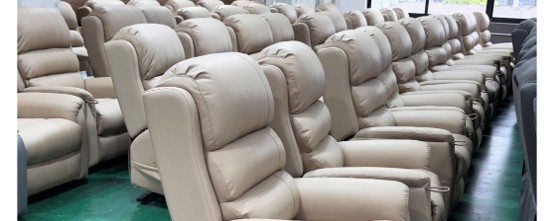
Where GeekSofa Fits Into This Type Of Project
At GeekSofa, we usually see Power Lift Chair projects more clearly when buyers describe the use environment first.
Is the chair for a private resident room, a shared lounge, a medical shop display, a home care channel, or an aged care project? Will the main concern be lift support, upholstery, appearance, load capacity, motor stability, or a mix of different room requirements?
GeekSofa’s product range includes Power Lift Chair and Medical Lift Chair options for care-related channels, not only ordinary recliner furniture. For care projects, the relevant details are usually practical:
l 17 years of manufacturing experience in recliner and lift chair categories
l 500+ model options for different seating and project needs
l In-house steel frame production
l International brand motor options
l Memory foam and easy-clean fabric / PU upholstery choices
l Medical lift chair options with up to 250 kg load capacity
l OEM / ODM support for distributors, care furniture buyers and private-label projects
These points are useful only when they match the care scenario. A higher load capacity is not meaningful for every room. A softer fabric may be right for one project but not for a high-cleaning shared space. A more home-like appearance may matter more in senior living than in a medical retail channel.
That is why the first discussion should not be “which model is cheapest?” or “which model has the most functions?”
A better starting point is:
Where will the chair be used, and what movement does it need to support every day?
A Practical Way To Think About The First Selection
For German care homes and care furniture distributors, the first Power Lift Chair selection can be divided by use area:
Resident rooms Focus on comfort, quiet motor movement, simple control and a warmer furniture look.
Shared lounges Focus on easy-clean materials, stronger daily-use structure and a design that does not look too medical.
Higher-support care areas Focus on frame strength, lift stability, seat dimensions and load capacity.
Medical shops and home care channels Focus on clear product explanation, user-friendly operation and model variety for different end users.
This kind of selection is not about overcomplicating the purchase. It helps avoid treating all care-home seating as one product category.
A Power Lift Chair works best when the model, resident profile and room purpose match each other.
For German Pflegeheim buyers, senior living furniture distributors or medical lift chair importers reviewing upcoming projects, GeekSofa can support model matching based on room use, upholstery preference, weight range and care scenario.
Share the type of care setting you are planning for, and we can help narrow the Power Lift Chair options before the furniture plan becomes too broad.
Post time: Jun-29-2026


