



Lift assistance is only the starting point
The lift function is the reason many buyers first look at this category.
A good Medical Lift Chair should support easier sit-to-stand movement without making the chair feel complicated. Smooth lifting, stable positioning, and easy hand-control operation matter because the chair may be used several times a day by people with different mobility levels.
In aged care and home care, the chair is also part of the wider furniture setting. A lift function alone does not make a product suitable for resident rooms or shared care spaces.
Recent healthcare furniture discussions have pointed in the same direction: seating is expected to support different heights, widths, and support levels so users can sit down and stand up more comfortably, while healthcare spaces are becoming warmer and more residential in appearance.
That is where the category becomes more interesting for B2B buyers.
A Power Lift Chair should help with movement, but it also needs to look and feel like seating that belongs in the room.
Long-use comfort matters in resident rooms and lounges
In retail furniture, comfort is often tested in a short showroom moment.
In aged care, the usage is different.
Residents may sit for extended periods throughout the day. The chair needs enough support through the back, seat, arms, and leg rest area. A soft-looking chair that sinks too much may not be ideal for all care settings; a chair that feels too firm may not be accepted for daily relaxation.
For this reason, comfort is not only about softness. It is about a balanced seating feel.
For GeekSofa Power Lift Chair projects, this is where product details such as high-density foam cushioning, supportive arm design, and adjustable tilt or reclining positions become relevant. They are not added as decorative specifications; they support the way the chair is used in daily care environments.
Aged care seating research has also highlighted the link between physical fit, independence, and comfort, while noting that facilities often need seating in both communal and public spaces and still want a home-like environment.
That matches what many care furniture buyers already know from experience: the chair has to work for real use, not just for a product photo.
Residential appearance is becoming part of care furniture value
Not every care space should look like a hospital ward.
Clinical areas have their own requirements, but many aged care houses, home care centers, and resident lounges are now designed to feel calmer and more familiar. Seating plays a large role in that atmosphere.
This is why the look of a Power Lift Chair matters.
The upholstery, color, cushion shape, stitching, arm style, and overall silhouette all affect how the chair sits in the space. A chair may provide mobility support, but if it looks too institutional for a resident room or lounge area, it may not fit the buyer’s intended environment.
Healthcare and senior living furniture suppliers are already using this language: residential-style frames, warmer materials, cleanable surfaces, and supportive comfort are appearing more often in seating discussions for long-term care and senior living spaces.
For GeekSofa, the product direction is not to turn a Power Lift Chair into an ordinary living-room recliner. It is to make the lift chair suitable for care channels while keeping a warmer furniture appearance.
That is why upholstery options matter. Different buyers may need different surfaces for medical shops, home care projects, aged care houses, or public hospital-related channels.
Simple operation is part of product acceptance
Power Lift Chairs are often discussed through functions: lift, recline, tilt, zero-gravity position, motor system, weight capacity.
Those features matter, but in care environments, operation has to remain easy.
A resident should be able to understand the main controls. A caregiver should be able to support use without dealing with unnecessary complexity. The remote position, cord management, button layout, movement smoothness, and noise level all affect the user experience.
This is one reason many care furniture buyers prefer products that keep functions practical instead of overloading the chair with every possible feature.
A chair used in an aged care room or home care environment has to feel reliable and familiar after repeated daily use.
Why product-line thinking matters for distributors
Medical shops and home care suppliers rarely build their market around one chair only.
They may need several Power Lift Chair options across different colors, upholstery choices, positioning functions, and price levels. An aged care house may want a softer residential look for resident rooms. A home care center may need a model that is easier to place in family living areas. A public hospital channel may focus more on durability, cleanability, and consistent supply.
That is why OEM/ODM support becomes practical.
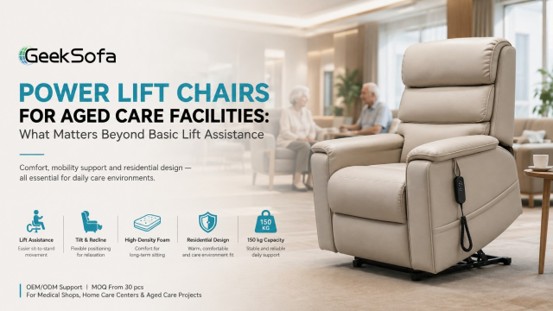
GeekSofa supports Power Lift Chair projects from 30 pcs, with product development around lift assistance, tilt and reclining functions, zero-gravity positioning, high-density foam seating, upholstery customization, and model options including 150 kg capacity depending on project requirements.
For healthcare furniture distributors, this helps build a product range instead of relying on one fixed specification.
Manufacturing support behind care seating
A Power Lift Chair for care environments has to bring several details together:
- ✓ lift assistance for easier sit-to-stand movement
- ✓ reclining and tilt positions for daily resting
- ✓ supportive cushioning for longer sitting periods
- ✓ upholstery options suitable for different care spaces
- ✓ simple controls for residents and carers
- ✓ stable structure for repeated use
- ✓ a design that fits medical and residential-style environments
GeekSofa works with medical shops, home care centers, aged care houses, and healthcare furniture distributors on Power Lift Chair development for different market needs.
For partners building a care seating range, the discussion usually starts with where the chair will be used: resident rooms, shared lounges, home care spaces, or medical retail channels.
From there, the product can be shaped around function, comfort, upholstery, color, and order requirements — with OEM/ODM support and MOQ from 30 pcs for Power Lift Chair projects.
Post time: Aug-27-2026


