



In many home care furniture ranges, the power lift chair is still introduced by one function first: helping the user stand.
That is understandable. The lift function is the most visible difference between a riser recliner chair and a standard recliner. But in daily use, one function does not define the whole chair.
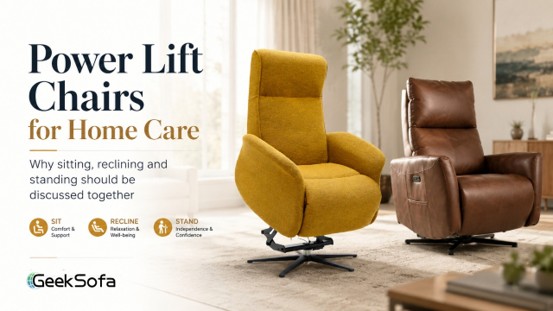
A user does not only “stand up” from a power lift chair. They sit down, rest, raise their legs, recline, return upright, shift their position, and then stand again. For mobility retailers, home care furniture buyers, and aged care seating suppliers, this makes the product conversation more complete than a simple lift-function description.
The chair has to support repeated movement across the day while still feeling like furniture that belongs in the home.
Why this matters in home care furniture
The UK is a useful market for this discussion because terms such as riser recliner chair, rise and recline chair, mobility equipment, and home care furniture are already common in buyer-facing product content.
The wider care environment also keeps home-based support in focus. Skills for Care reported that England’s adult social care vacancy rate fell to 7% in 2024/25, while CQC noted that homecare vacancy rates in March 2025 were just over 10%, more than double the rate for care homes. These figures should not be turned into a direct product-demand claim, but they do show why practical support at home remains part of the care conversation.
For many reduced-mobility users, the role of a power lift chair is not dramatic. It is connected to ordinary daily moments: getting into the chair, resting for longer periods, reclining into a comfortable position, and standing with powered assistance when needed.
That is different from ordinary recliner comfort.
The lift function is only one part of the movement
A power lift chair can look impressive when it rises, but buyers know the real experience is broader.
The movement from seated to reclined position should feel controlled. The leg support should make resting easier without forcing the body into an awkward angle. The return-to-upright movement should feel steady enough for the user to prepare for standing.
This is why buyer-facing content often discusses motor options, backrest movement, and leg support together. CareCo explains single motor and dual motor riser recliners by how the backrest and footrest move together or independently, which shows how much the user experience depends on movement control rather than lift alone.
For home care furniture buyers, this matters because end users rarely describe the chair in technical terms. They notice whether the movement feels smooth, whether the chair gives them enough time to adjust, and whether it feels natural to move from resting to standing.
Seated comfort and standing support are connected
Comfort is still central to a riser recliner chair, but home care comfort is not only about softness.
A chair may feel comfortable at first, but if the seat is too deep or too soft, the user may struggle to move forward before standing. If the armrests do not feel supportive during the transition, the lift function alone may not make the chair feel easier to use. If the backrest feels too flat or too firm, longer sitting becomes less comfortable even if the mechanism works well.
That is why backrest design appears so often in mobility seating content. Modern Mobility discusses backrest options such as waterfall, button, and lateral styles in relation to support and comfort. For home care ranges, these details are not decorative language; they affect how the chair feels through sitting, resting, and standing.
The better discussion is not whether comfort matters. It is how comfort works together with powered movement.
Home-style appearance still has a role
A home care power lift chair should not make the living room feel like a clinical space.
This is not a minor point. Many users are more willing to accept powered support when the chair still looks and feels like home furniture. Families also tend to prefer a chair that blends into a normal room rather than making the home feel like a care facility.
But appearance cannot carry the product on its own. The chair still needs stable movement, supportive cushioning, practical upholstery, and a frame built for repeated powered use.
For buyers, this is where the category becomes specific. A power lift chair is not simply a soft recliner with an electric function added. It is also not automatically specialist clinical seating. It has its own role: home-style furniture with powered support for daily seated movement.
Where manufacturing detail becomes relevant
Most of the working structure of a finished power lift chair is hidden under upholstery. The end user sees the cover, back shape, cushion form, armrests, and remote control first.
The daily experience comes from the parts they do not see.
For GeekSofa, the relevant manufacturing details are those that connect directly to home care use. Self-produced iron frames support closer control over the internal structure used in powered models. International-brand motors help the chair move more smoothly through lift and recline actions. Memory foam cushions support seated comfort for longer daily use. Wear-resistant, stain-resistant, and easy-clean fabric options are better suited to frequent home care use than purely decorative upholstery.
The company’s 500+ model base and OEM/ODM capability also matter when buyers need range flexibility. A wider model base gives mobility retailers and home care furniture buyers room to build ranges that feel residential, mobility-focused, or care-home friendly without forcing every product into the same visual style.
That is where manufacturing support becomes useful for buyer decision-making: not by adding more claims, but by helping the product fit the way it will actually be used.
A more practical way to discuss power lift chairs
A good home care power lift chair should not be reduced to “it helps people stand.”
The more relevant question is how the chair supports repeated daily movement: sitting, resting, reclining, returning upright, and standing. Each movement depends on the same product details — frame structure, motor movement, cushion support, backrest comfort, and upholstery performance.
For mobility equipment distributors, home care furniture buyers, and aged care seating suppliers, that is where the category has real value.
The chair still needs to feel like furniture. It also needs to support the repeated movements that define daily home care use.
Post time: Aug-13-2026


