



For many furniture buyers, a recliner sofa project starts with the same questions: Does the model look good? Is the price workable? Can the fabric match the market? How many pieces fit in a container?
Those questions still matter. But when a recliner sofa order moves from sample approval to bulk production, the real test often becomes more practical:
Can the same sofa be repeated — in comfort, fabric, structure, packaging and delivery rhythm — across the whole order?
That is where a factory floor can tell buyers more than a polished catalog image.
A Good Sample Is Only The First Checkpoint
A single recliner sofa sample can look convincing in a showroom or product photo. The seat may feel soft, the back cushion may look full, and the grey fabric may appear safe for multiple markets.
But importers, distributors and retail furniture buyers rarely build a business on one sample. They build it on repeatable orders.
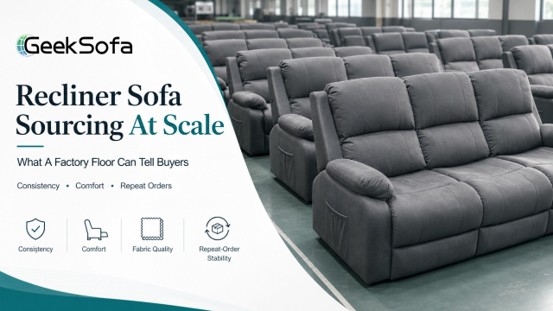
When several rows of the same recliner sofa are waiting for inspection, the question changes. Buyers are no longer looking at “one nice model.” They are looking at production consistency.
Are the back cushions aligned? Is the seat support similar across units? Does the fabric color stay consistent from one sofa to another? Are the armrests shaped evenly? Will the second shipment match the first one when the model starts selling?
For recliner sofa buyers, this is where many hidden risks begin. A product that looks right in the sample room may create problems later if bulk production cannot hold the same standard.
The Market Is Asking For Comfort — But Buyers Need More Than A Soft Seat
Recliner sofas are no longer treated only as bulky comfort furniture. In many markets, they are becoming part of the main living room assortment.
Retailers are paying more attention to deep seating, powered recliners, modular layouts and multifunctional living room furniture. Consumers want sofas that feel comfortable after work, fit apartment or villa living rooms, and still look presentable in a modern home.
That creates an opportunity for furniture importers and distributors. But it also raises the standard.
A recliner sofa is judged every day after delivery — not only when it arrives at the warehouse. The end user sits, reclines, leans on the armrest, uses the mechanism, cleans the fabric and expects the sofa to keep its shape.
So for buyers, comfort is not just a selling point. It is a long-term product risk.
The real questions are inside the sofa:
l Does the frame support daily use?
l Does the foam recover well after repeated seating?
l Does the reclining mechanism operate smoothly?
l Does the seat feel consistent from left to right?
l Does the back cushion keep its shape after compression and shipping?
This is why factory capability matters. For example, GeekSofa’s in-house steel frame production, memory foam application and focus on motor / mechanism reliability are not just technical details. They match the parts of a recliner sofa that buyers usually cannot see in a product photo, but customers will feel after months of use.
Fabric Choice Is Also A Commercial Decision
Grey recliner sofas remain popular for a reason. For many importers and retailers, grey is a safer color for broad distribution. It works in apartments, family homes, showroom displays and mixed living room collections. It can fit Europe, Latin America, the Middle East and Australia/New Zealand without feeling too specific to one interior style.
But a “safe color” does not remove sourcing risk.
For bulk orders, buyers still need to think about fabric consistency and after-sales exposure. A grey fabric recliner sofa can become a problem if the batch color shifts, the surface pills too quickly, or the material is difficult to clean in daily family use.
This is especially important for recliner sofas because they are high-contact furniture. Customers use the headrest, armrest and seat cushion repeatedly. These areas show wear faster than decorative furniture.
For a distributor, fabric is not only about design preference. It affects return rates, customer reviews, showroom confidence and repeat-order stability.
That is why buyers should connect fabric selection with the target market. A showroom buyer may prioritize handfeel and appearance. A wholesaler may care more about durability and easy-clean performance. A project buyer may need consistent color across a larger quantity. These are different decisions, even when the product is called the same thing: a grey recliner sofa.
Mixed Container Orders Need More Than Product Variety
Many buyers like mixed container orders because they reduce inventory pressure. This is especially true for furniture distributors testing new recliner sofa lines, or importers who want to combine manual recliners, power recliner sofas, corner recliners and living room sofas in one shipment.
But mixed container sourcing is not just about putting different models into the same container.
It requires the supplier to manage model combinations, fabric options, packaging sizes, loading plans, production timing and delivery coordination. If one model is delayed, the whole shipment can be affected. If one fabric batch changes, the line may look inconsistent. If packaging is not planned properly, damage risk increases during long-distance transport.
This is where buyers need to separate “we can offer many models” from “we can manage a mixed order properly.”
GeekSofa’s 500+ model base is useful only when it helps buyers build a workable recliner sofa line — not just when it looks impressive in a catalog. The value is in giving distributors and retailers more room to test different layouts, price points and materials without changing suppliers too often.
The same applies to mixed container support. For a buyer, the benefit is not variety for its own sake. The benefit is lower inventory pressure, better assortment planning and more flexible market testing.
Production Rhythm Becomes Important After The First Order Sells
The first order is often about market entry. The second and third orders are where the real supplier relationship begins.
If a recliner sofa starts selling well, buyers need repeat orders to arrive on time and remain consistent with the first shipment. Delayed replenishment can break retail momentum. Product variation can create customer complaints. Unstable delivery can force distributors to switch models before the market has fully responded.
This is why delivery rhythm matters.
For recliner sofa buyers, a supplier’s production capacity should not be understood only as “how many containers can be shipped.” It should be understood as whether the supplier can support repeat business.
GeekSofa’s 25–30 day delivery cycle and monthly shipment capacity of around 200–220 containers are relevant here because they connect directly with buyer-side pressure: keeping stock moving, supporting repeat orders, and reducing the risk of missed sales windows.
Again, the point is not to promote capacity for its own sake. The point is whether production rhythm supports the buyer’s business model.
A small retailer testing a new sofa line may need flexible order planning. A distributor may need regular replenishment. A project buyer may need unified delivery across multiple units. These are different needs, but they all depend on stable production management.
What Buyers Can Read From A Factory Floor
A factory-floor view of recliner sofas is not as polished as a lifestyle image. But for B2B buyers, it can be more useful.
It shows whether a model is being produced repeatedly. It shows whether the supplier is working beyond single-sample presentation. It reminds buyers to check consistency, not just appearance. It brings the conversation back to what actually affects bulk orders.
For furniture importers, the key question is not only whether the price is competitive. For distributors, it is not only whether enough models are available. For retail buyers, it is not only whether the sofa looks good in a showroom. For OEM / ODM sourcing managers, it is not only whether the design can be customized.
The better question is:
Can the supplier repeat the same comfort, fabric, structure and delivery rhythm when the order moves from one approved sample to full production?
That is what turns a recliner sofa from a product listing into a reliable business line.
And in today’s recliner sofa market, where comfort, modular living and flexible assortment planning are becoming more important, that reliability may be the difference between a one-time order and a product line that buyers can keep selling.
Post time: Jun-02-2026


