



In today’s furniture market, recliners are no longer seen as oversized “TV chairs” reserved for one corner of the living room. Across Europe, the Middle East, Australia, and Latin America, modern recliners are becoming part of everyday living spaces — from compact urban apartments in Denmark to large family villas in Saudi Arabia.
At the same time, buyer expectations have changed.
Furniture retailers, interior sourcing teams, and furniture brands are paying closer attention to long-term comfort, material durability, after-sales stability, and how a recliner performs after months of daily use — not just how it looks in a showroom.
And that shift is changing the conversation around recliner manufacturing.
The Market Is Moving Toward Long-Term Comfort, Not Just Function
A few years ago, many recliner discussions focused heavily on added features: massage, cup holders, LED lighting, or oversized styling.
Today, the market feels different.
European buyers are increasingly asking for cleaner silhouettes, quieter reclining systems, durable upholstery, and seating that fits modern interiors without looking bulky. In Australia, there is growing interest in ergonomic support and daily comfort for multi-generational households. In the Middle East, buyers still prefer generous seating proportions, but they are also paying more attention to heat-resistant upholstery and material longevity in warmer climates.
Across all these regions, one concern appears repeatedly:
“How well will this recliner hold up after one or two years of regular use?”
That concern is reasonable. Recliners are mechanical furniture products used daily, often for extended sitting hours. Unlike occasional-use furniture, they experience repeated pressure on the seat structure, reclining mechanism, foam support, stitching, and upholstery.
This is why durability has become part of the buying decision — especially for distributors, furniture retailers, and project buyers who want to reduce warranty claims and maintain customer satisfaction.
Why Some Recliners Age Faster Than Expected
Most recliner problems do not appear immediately.
The first few months usually feel comfortable. Issues tend to show up later through everyday use patterns:
Seat cushions gradually losing support
Upholstery peeling or cracking in humid or high-temperature environments
Reclining mechanisms becoming noisy
Armrests loosening over time
Foam compression creating uneven seating
Visible sagging after long sitting periods
In many cases, these issues are not caused by a single component. They are often the result of small compromises throughout the manufacturing process.
For example, seat comfort is not only about using “soft foam.” A recliner designed for daily use needs balanced support underneath the upholstery. Many manufacturers are now combining pocket spring systems with high-density foam and doll cotton filling to improve long-term seating resilience and reduce sagging.
The same applies to frame stability. A recliner may look identical from the outside, but internal structure matters more than most end users realize. Stronger steel mechanisms, reinforced wooden structures, and stable stapling and glue processes all influence how the chair performs after thousands of reclining cycles.
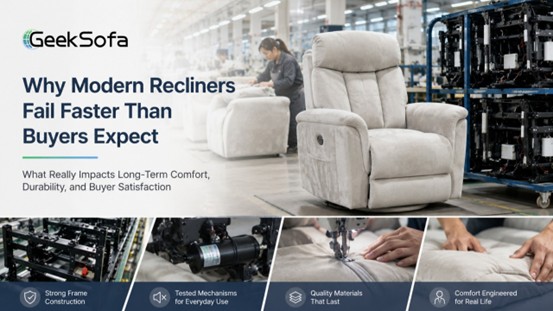
At GeekSofa, our reclining mechanisms and motors undergo continuous cycle testing during development. Some mechanisms have already exceeded 17,000 reclining cycles in internal testing environments. The goal is not to create “extreme specifications” for marketing purposes, but to improve consistency during everyday use.
Upholstery Is Becoming a Bigger Decision Factor
Material selection is another area receiving more attention from buyers.
In hotter regions such as Saudi Arabia, Kuwait, and parts of Latin America, furniture distributors increasingly ask about hydrolysis resistance and fabric durability. Peeling leather surfaces and worn upholstery can quickly affect customer perception, even when the chair structure itself remains functional.
Because of this, more buyers are moving toward durable performance fabrics, scratch-resistant textiles, and upgraded leather solutions designed for longer product lifespans.
Chenille fabrics, for example, are returning in many premium recliner collections because they combine soft texture with a more contemporary visual appearance. Buyers also appreciate fabrics that are easier to maintain in family living environments.
For project-based buyers and retailers, easy-clean surfaces and stain resistance are becoming practical selling points rather than luxury extras.
Manufacturing Details Buyers Are Starting to Notice
Another interesting shift is the growing interest in manufacturing transparency.
Furniture buyers today often want to see more than finished product photos. They are paying closer attention to:
Recliner frame construction
Upholstery stitching quality
Foam layering
Mechanism assembly
Factory testing procedures
Material sourcing consistency
This is especially true in European markets where long-term supplier reliability is becoming just as important as product styling.
In our own production process, every recliner passes through multiple stages including material cutting, sewing, cotton filling, wooden frame assembly, upholstery, mechanism installation, and finished product testing before shipment.
These steps may sound ordinary, but consistency at each stage directly affects product performance later in the customer’s home.
Recliners Are Becoming Part of Modern Living Design
Another reason recliner expectations are changing is because recliners themselves are changing.
Today’s buyers are looking for recliners that fit naturally into modern living spaces rather than standing out as purely functional furniture. Compact proportions, cleaner lines, textured fabrics, quieter motion systems, and balanced comfort are becoming more important than exaggerated styling.
The market is gradually moving toward what many buyers describe as “comfortable living without compromise” — furniture that feels practical for daily use while still matching contemporary interiors.
For manufacturers, that means durability and comfort can no longer be treated separately from design.
Conclusion
Modern recliners are expected to do more than ever before. Buyers want comfort, durability, clean aesthetics, quiet operation, and materials that continue performing well after daily use.
As the market evolves, the discussion is also becoming more mature. Instead of focusing only on features, more furniture buyers are evaluating how recliners are engineered, how materials age, and how seating performs over time in real living environments.
For manufacturers and furniture brands alike, long-term comfort is no longer just a product feature. It is becoming part of the overall customer experience.
FAQ
1. What causes recliner chairs to sag over time?
Seat sagging is usually related to foam density, seat support structure, and long-term compression from daily use. Pocket springs combined with high-density foam can help improve seating resilience.
2. Why does recliner upholstery peel in some climates?
Heat, humidity, and material quality all affect upholstery lifespan. Hydrolysis-resistant leather and durable performance fabrics are commonly used to improve longevity in warmer regions.
3. Are power recliners more durable than manual recliners?
Durability depends more on mechanism quality and structural design than whether the recliner is manual or electric.
4. What are buyers looking for in modern recliners today?
Most buyers focus on long-term comfort, quiet reclining systems, durable upholstery, modern styling, and stable product quality.
5. Why are furniture buyers asking more about manufacturing processes?
Retailers and distributors increasingly want consistent product quality and lower after-sales risk, so they pay closer attention to frame construction, testing procedures, and material selection.
Post time: May-14-2026


